
By Dr Odeen Ishmael
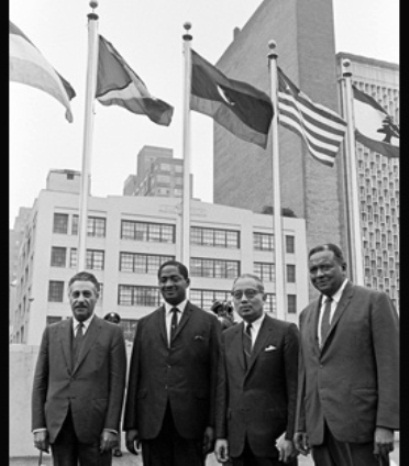
Throughout the early part of 1966, preparations for Guyana’s independence celebrations went in full swing. A special committee appointed by the government designed the new coat of arms and selected the Canje pheasant as the national bird.
The design and colours of the new flag, appropriately called “The Golden Arrowhead”, had already been chosen during the period of the PPP government from entries submitted through an international competition. The winning five-coloured design was submitted by an American, Whitney Smith. The name chosen for the independent nation – Guyana – was also chosen since 1962 by a select committee appointed by the House of Assembly.
The flag of Guyana was designed with a golden arrowhead along its middle to signify Guyana’s journey into the future. The golden arrowhead, with narrow white and black strips along its sides, was set on a green and red background with narrow white and black strips along the sides of the arrowhead. The five colours were also seen as symbolic to the country various assets: green for the agriculture and forests; gold representing the country’s mineral wealth; red for the zeal of nation-building; black border, depicting the people’s endurance; and white symbolising the natural water potential of the country.
A nation-wide competition, sponsored by the National History and Arts Council, also helped to select the words of the new national anthem. The winning entry, “Green Land of Guyana”, was written by Reverend Archibald Luker, and the words were set to music by Cyril G. Potter, a prominent Guyanese educator and musician.
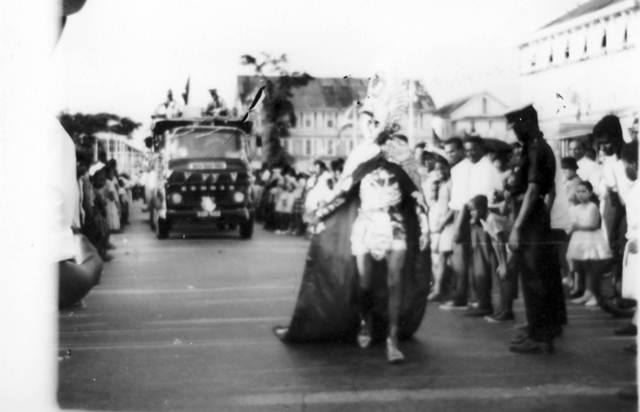
Guyana became an independent nation on Thursday, 26 May 1966, but the independence celebrations began four days before and continued until 29 May. Public buildings and business places were brightly decorated with streamers and buntings bearing the colours of the Guyana flag.
On the evening of 25 May, a grand cultural performance took place at the Queen Elizabeth Park (later to be renamed the National Park). Dignitaries in the audience of thousands included the Duke and Duchess of Kent, representing Queen Elizabeth, and representatives of foreign governments.
Then at midnight, the Union Jack, the symbol of British colonial rule for 163 years, was lowered and the new flag of Guyana, the Golden Arrowhead, was raised to the top of the mast. Just before the flag raising ceremony before a huge crowd, Prime Minister Forbes Burnham and Opposition Leader Cheddi Jagan publicly embraced each other, indicating their satisfaction that Guyana had finally won its political independence.
With the raising of the new flag, fireworks burst across the sky in various parts of the country. Then around mid-morning, the State opening of the Parliament of Guyana took place. It was preceded by a military parade accompanied by much pomp and pageantry. Significantly, for this occasion, a portrait of Sir Walter Raleigh decorating the wall of the Parliament chamber was removed and replaced with a portrait of Prime Minister Burnham.
Comments are closed.